I love food. I must confess, I haven’t always loved it. Getting me to eat when I was a kid was… difficult. I hated breakfast. My mom had to force feed me scrambled eggs. I don’t like the runny whites in a sunny side up, and early in the morning, with making breakfast and lunch for her boys, I couldn’t very well expect her to make it bone dry. And she had to force feed me because she found out I wouldn’t eat lunch. I was busy running around school during the lunch breaks. I’m glad I did. I wouldn’t want to look in the mirror anymore if I did eat all that she gave me for lunch. A few more kilos certainly would hurt.
Those days changed when I went to Delhi. A boy that wouldn’t eat one handful of rice, or one chapatti, now seamlessly devoured 8-10. My mom would cook enough in the morning for lunch and dinner so she wouldn’t have to cook twice and the little devil that I am, I enjoyed making her go cook again. But in my defense, I used to help her cook and clean, or any little thing I could that she would allow me to do.
Ever since then, I have been obsessed with food. From grossly underweight to undeniably over-weight, and living in three out of 4 cultural hubs of the country meant I had the fortune and opportunities to sample “local” cuisine. And now I love food even more. I expected the romance would end as I would be forced to enter the “female domain”, but it hasn’t been so.
Hoping that my appetite for good food will remain consistent over time, I decided to make my own list of Must-eats, like the 50 Things to eat before you die list that BBC viewers created, but unlike BBC, you are not welcome to vote or append my list. I would like to think my list is a bit more global, a lot more “worldly” and definitely less prejudiced than those stinking pommy bastards that voted fish and chips numero uno. But you may comment, for the sake of free speech and bullshit.
This list isn’t a list of cuisines I have sampled. In fact, chances are, I have never eaten any of these. But then what is the fun of making a list of must eats that have already been sampled. That would limit the possibilities and make this redundant for my own personal benefit. In making this list completely new to myself, I have opened a venue onto myself of places to see and things to eat. So this is a working and constructive list, rather than an omissive list that chooses to critique dishes and recipes. In the end, my list isn’t necessarily a list of Must eats, as much as it is a cultural exploration, which provided with sufficient time and money, I wish to carry out during my time on this shithole we call planet earth. As I said, this is more of a cultural exploration, so don’t expect to see single dish names, but generally cuisines I think I will enjoy and the types of dishes named are just illustrative, and I hope not to limit myself to those when the actual opportunity arrives.
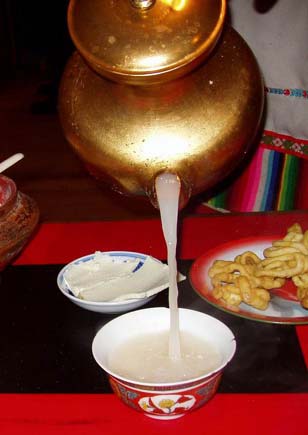
- “Roof of the world” at an average elevation of 5km, Tibet. Home to the now exiled Dalai Lama, Tenzin Gyatso, home as well to the Momo and Butter Tea. Tibet’s proximity to the Indian and Chinese civilizations doesn’t say much about its cuisine, its isolated location within the lap of the Himalayan mountain ranges and its cold harsh weather promises an entirely different variety of cuisine. The momo was recommended by a friend and hopefully companion on these gastronomical expeditions. In addition to these two, the mountains find themselves to be the home of the Yak, a low-cholesterol, low-fat beef replacement. Whether as a “spicy stew” or a juicy rib-eye, I can’t bother much. It will be fun meeting the prospective future of beef!
- World’s Food Fair; Honk Kong. The fusion of eastern and western cuisine, without being blasphemous (or so I presume). Ruled by the british and now part of PRC, they probably have the best expertise at attempting this sort of fusion. And where else can you get shark fin soup! Alright, lots of places, but I’m sick of Chinese cuisine and this is as close to Chinese food I will allow myself.

@ The Yung Kee Restaurant 32-40 Wellington Street, Central, Hong Kong “The American Bison is a bovine mammal, also commonly known as the American Buffalo, or simply buffalo, something of a misnomer as it is only distantly related to either of the two "true buffalos": the Water Buffalo and the African Buffalo.” – Source Wiki
“Bison is one of the fastest growing segments of American Agriculture. The bison is very low maintenance and a very efficient grazing animal. Bison meat is much lower in fat and cholesterol than other meats but it maintains a very high protein level. Bison meat has a clear-cut advantage in our 'heart healthy' society.” – Iowa Bison AssociationSpecies Fat (g) Calories (kcal) Cholestrol (mg) Protein (g) Bison-Buffalo 2.42 143 82 33 Beef 9.3 211 86 20.78 Chicken * 7.41 190 89 23.09 Pork 10.5 215 92 20.99 Beefalo 4.8 143 44 23.30
*Skinless
Source: The Buffalo Shop, USDA National Nutrient Database
And it cooks faster :D. Less fat, less insulation, less heat and time needed to cook the same meat. Flipside? Overcooking is a serious danger and can leave the meat dry. But I’m not worried, I’m getting my steak cooked by a pro. Who said health food can’t be tasty?- To the land of the rising sun, to learn their art of marketing, manufacturing philosophies, and business stratagem. Who am I kidding? I’m going there for their Sashimi, Shochu, Awamori…
Japan has some amazing alcoholic beverages. I was lucky enough to have an uncle who totally hated it at first taste and wasn’t tolerant enough to give it a chance. As I said, his loss was my gain and a full bottle of sake is certainly a nice gain.
A bit of yakitori (bite-sized pieces of chicken meat, served with tare sauce, which is basically made up of mirin, sweet sake, soy sauce and sugar) with Awamori (alcoholic beverage indigenous to and unique to Okinawa, distilled) sounds good. They suggest a beer with your yakitori. But awamori sounds better. The booze actually catches fire at 120 proof.
I’m still a bit queasy at the prospect of eating raw fish, so until I can get up the courage, I’ll stick with Tataki, a variant of Sashimi that has raw Tuna/Beef seared on the outside. Served with spring onions, ginger and garlic paste. Is it blasphemous to have wasabi with this, will surely make for an eye-watering experience. Shochu sounds great to wash it down.
Mother Russia how are you sleeping
Middle winter cold winds blow
From the trees the snowflakes drifting
Swirling round like ghosts in the snow
Mother Russia poetry majestic
Tells the time of a great empire
Turning round the old man ponders
Reminiscing an age gone by
Mother Russia
Dance of the czars
Hold up your heads
Be proud of what you are
This is the last one of the first installment. I can’t stand it anymore!!! The more I read about the stuff I want to eat (eventually!!!) the more I WANT to eat it, NOW!
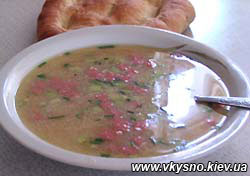
Botvin`ya (typical cold Russian soups, that almost went extinct because it is very hard to make)
A full botvin'ya consists of three parts:
1. The soup.
2. Boiled "red" (most prized) fish (salmon, sturgeon, or stellate sturgeon), that is served separately from soup.
3. Crushed ice, served on a separate platter or cup.
It is eaten as first course or right after a hot soup, before the second course as an appetizer. You have to eat it with two spoons and a fork: the fork is used to take the fish, the first spoon to sip the soup and the second spoon to put ice into the soup, so it stays cold for a long time. Botvin'ya is eaten with fresh rye bread.
Veal Orloff (braised loin of veal, thinly sliced, filled with a thin layer of pureed mushrooms and onions between each slice, and stacked back. It is then topped with bechamel sauce and cheese and browned in the oven.)
Kvass (fermented mildly alcoholic beverage made from black or rye bread, alcohol content is so low, 1-1.5%, often flavored with fruits or herbs such as strawberries or mint.)
Meat Solyanka (ingredients like beef, ham, chicken breasts, and cabbage, together with salty mushrooms, cucumber pickles, tomatoes, onions, olives, capers, allspice, parsley, and dill are all cut fine and mingled with cream in a pot. The broth is added, and all shortly heated in the stove, without boiling.)
Okroshka (cold soup, mix of mostly raw vegetables (like cucumbers, spring onion, radish), boiled potatoes, eggs, ham with the beverage kvass.)
Shashlik (a form of Shish kebab, generally beef, pork, or lamb)
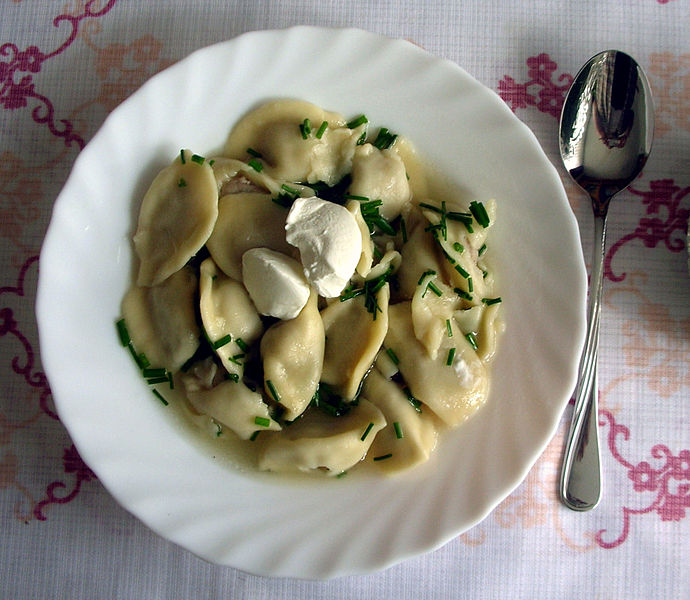
Pelmeni (usually made with minced meat filling, wrapped in thin dough (made out of flour and eggs, sometimes with milk or water added). Often various spices, such as pepper and onions are mixed into the filling. Pelmeni are eaten by boiling in water until they float, and then 2-5 minutes more. The resulting dish is served with butter and/or sour cream.